
Luxury Golden Triangle with Ranthambhore National Park Tour
By KindQuest Travel
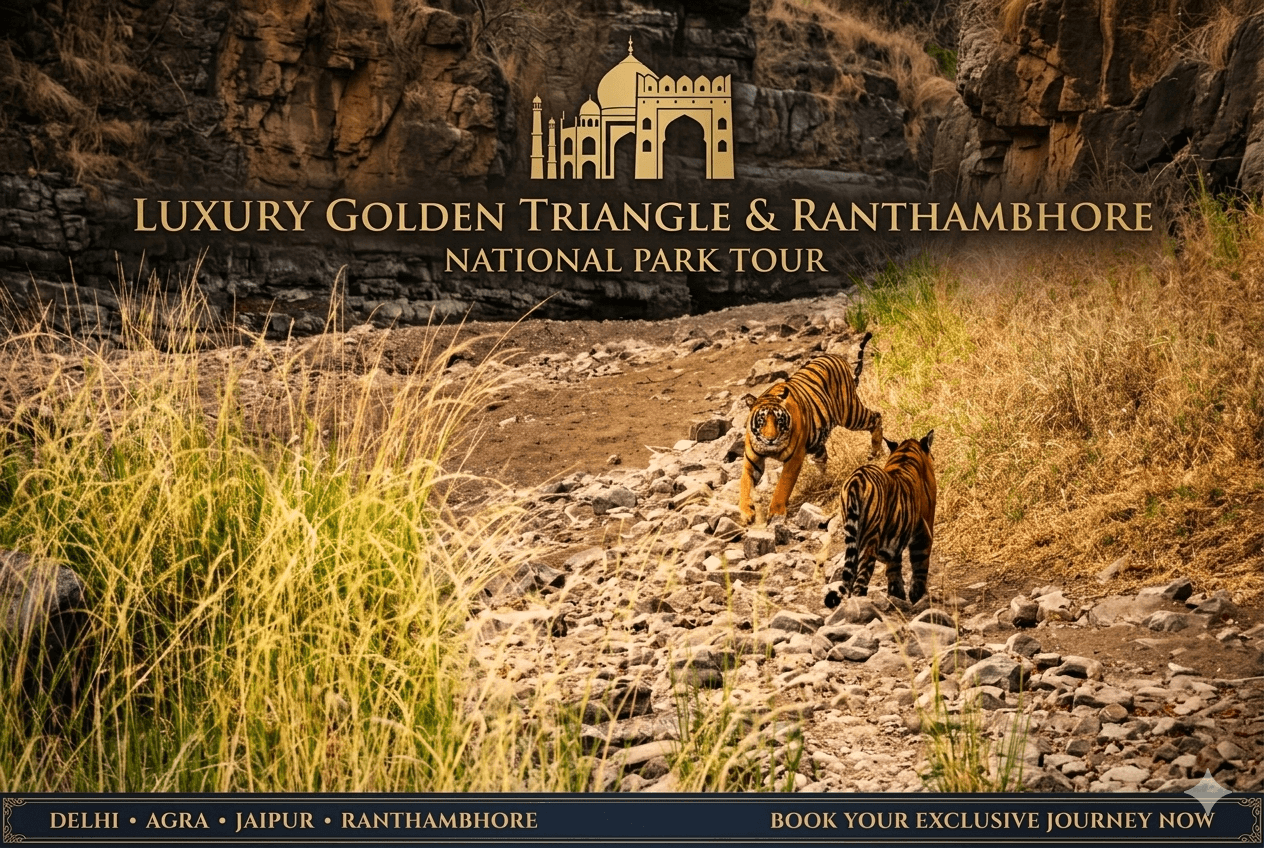
There's a particular fatigue that sets in around the third fort of a heritage tour — the columns start to blur, the dates start to overlap, and even a devoted history lover starts checking the time. Extending a Golden Triangle itinerary into Ranthambhore solves that without anyone having to admit the fatigue existed in the first place. Three or four days of palaces, tombs and bazaars, and then suddenly you're in an open jeep before sunrise, engine off, watching the grass for the flick of an ear that might belong to a Bengal tiger. That contrast is the entire point of pairing the two.
What Is the Golden Triangle, and Why Add Ranthambhore?
The Golden Triangle refers to Delhi, Agra and Jaipur — three cities roughly 200–250 km apart that form a loose triangle on the map of northern India. Each anchors a different chapter of the country's history: Delhi as a seat of power rebuilt by one empire after another, Agra as the city built around a single monument that needs no introduction, and Jaipur as the planned capital of a Rajput kingdom that never quite stopped feeling royal. Together they're the most travelled circuit in the country, and for good reason.
Ranthambhore sits a few hours south of Jaipur, and adding it changes the rhythm of the whole trip. Where Delhi, Agra and Jaipur have you looking up at domes and ramparts, Ranthambhore has you sitting still and watching the grass — and most travellers who add the extra two or three days say that's the part they end up talking about longest.
Delhi
Delhi rarely lets you forget how many times it's been rebuilt. Old Delhi carries the seventeenth-century Mughal city — red sandstone forts, the country's largest mosque, and lanes narrow enough that a cycle rickshaw is still the fastest way through Chandni Chowk's spice and silver markets. A short drive away, New Delhi unfolds into wide colonial-era avenues and the ceremonial sweep leading to India Gate. Underneath both sits an older city still — legend places an early capital here more than three thousand years ago, and the medieval Qutub complex is proof Delhi was changing hands long before the Mughals arrived. Two days is usually enough for the major sights without rushing the bazaar walk, which works best slowly, on foot, as the evening lights come on.
Agra
Everything about Agra exists in relation to one building. The Taj Mahal is best seen at sunrise, when mist still sits on the Yamuna and the white marble shifts from grey to pink to gold as the light changes — it's also closed on Fridays, worth building into your dates. Up close, the pietra dura inlay work rewards slow, guided viewing, ideally before the crowds arrive. Agra Fort tells the darker half of the story: it's where the emperor who built the Taj later spent his final years under house arrest, with a distant view of his own creation. A detour toward Jaipur brings you to Fatehpur Sikri, a red sandstone capital built, occupied and abandoned within a few decades after its water supply failed — remarkably intact and far less visited. The Itmad-ud-Daulah tomb, nicknamed the Baby Taj, is a quieter white-marble precursor worth the half hour it takes to see.
Jaipur
Jaipur earned its nickname in the 1870s, when the old city was painted terracotta pink to welcome a visiting royal guest — a heritage law has kept the colour ever since. Amber Fort, on a hillside just outside the city, remains the grandest half-day excursion: mirrored halls, and a hilltop view that explains exactly why the Rajput rulers picked this spot. Inside the city walls, the Hawa Mahal's honeycomb facade of nearly a thousand latticed windows was built so royal women could watch street life below without being seen — from the street it reads less like a building and more like pink lacework. The City Palace, still partly home to the former royal family, holds textiles, manuscripts and armouries open to visitors, and the nearby Jantar Mantar observatory's giant stone instruments still track celestial positions with startling accuracy, three hundred years on.
Ranthambhore
Ranthambhore was once the private hunting ground of Jaipur's maharajas before becoming one of India's first tiger reserves under Project Tiger in the 1970s. A tenth-century fort still stands inside the park boundary, visible from several safari routes — a reminder that even the wilderness here has a royal backstory. Safaris run in two windows, morning and afternoon, and a private jeep offers a more flexible experience than the larger shared canter. There are no guarantees with wild tigers, but Ranthambhore has one of the stronger sighting records among India's reserves — and beyond the tiger, the park holds leopards, sloth bears, marsh crocodiles, the hard-ground barasingha found almost nowhere else, and well over two hundred recorded bird species.
A Sample Eight-Day Itinerary
- Day 1 — Delhi. Arrive, private transfer to a heritage hotel, evening left open or an early walk near Humayun's Tomb.
- Day 2 — Delhi. Old and New Delhi by day, guided bazaar walk and rickshaw ride through Chandni Chowk as the lights come on.
- Day 3 — Drive to Agra (3–4 hours). Afternoon at Agra Fort and the Itmad-ud-Daulah tomb.
- Day 4 — Sunrise at the Taj Mahal, then drive to Jaipur via Fatehpur Sikri.
- Day 5 — Jaipur. Amber Fort in the morning; City Palace, Hawa Mahal and Jantar Mantar across the afternoon.
- Day 6 — Drive to Ranthambhore (about 4 hours). Check into a jungle lodge; evening safari.
- Day 7 — Ranthambhore. A full day in the park, morning and afternoon game drives.
- Day 8 — Transfer to Jaipur (about 4 hours) for an onward flight, or add a night before departure.
When to Go
October through March gives the most comfortable temperatures for walking around forts and palaces. Tiger sightings, somewhat counterintuitively, tend to improve in the hotter months of April through June, when sparse foliage and shrinking waterholes concentrate wildlife in predictable spots — some travellers split the difference and go in February, March, or late October.
What Makes It "Luxury"
On a route this well-travelled, the difference between an ordinary trip and a luxury one comes down to a handful of choices: heritage palace hotels and boutique jungle lodges instead of standard chain properties, a private vehicle and driver for the whole circuit, an exclusive jeep safari instead of a shared canter, monument visits timed around sunrise and dusk to dodge both the crowds and the harsh midday light, and a guide who can actually hold a conversation about Mughal architecture rather than recite a script.
Frequently Asked Questions
How many days do you need for the Golden Triangle plus Ranthambhore?
Eight days is a comfortable, unhurried minimum — two in Delhi, one to two in Agra, two in Jaipur, and two in Ranthambhore, with travel days built in.
Is Ranthambhore worth adding to a Delhi-Agra-Jaipur trip?
For most travellers, yes — it breaks up monument fatigue with an entirely different rhythm and is one of India's more reliable parks for tiger sightings.
Is the Taj Mahal open every day?
No — it's closed to visitors on Fridays, so factor that into your dates.
How do you travel between the four destinations?
Most luxury itineraries use a private air-conditioned vehicle for the whole road circuit; the return leg is typically by car to Jaipur followed by a flight, since Ranthambhore has no airport of its own.