
Banaras: The City Your Soul Understands Before Your Words Do
By KindQuest Travel
Almost everyone who arrives in Banaras has the same moment, usually within the first hour — often on a boat, or in a lane too narrow for the word "lane" to really cover it. Marigolds, temple bells, a cow ambling past a wall that's been standing for five hundred years, a boatman humming something that sounds older than the river itself. Somewhere underneath all of that, before you've fully processed it, something in you has already understood the place.
What Makes Banaras Different
Varanasi — known locally as Banaras, and spiritually as Kashi — is widely considered one of the oldest continuously inhabited cities on earth. What sets it apart isn't any single monument; it's how naturally the sacred and the everyday sit side by side. Vegetable sellers set up next to centuries-old shrines, and it isn't unusual for a wedding procession and a funeral procession to cross paths on the same lane.
The Ghats
Eighty-odd stone staircases run along the riverfront and form the real spine of the city. A dawn boat ride past them is the classic Banaras experience — priests at their morning rituals, widows in quiet prayer, children playing, elderly regulars going through routines they've kept for decades, all facing the Ganga.
Ganga Aarti
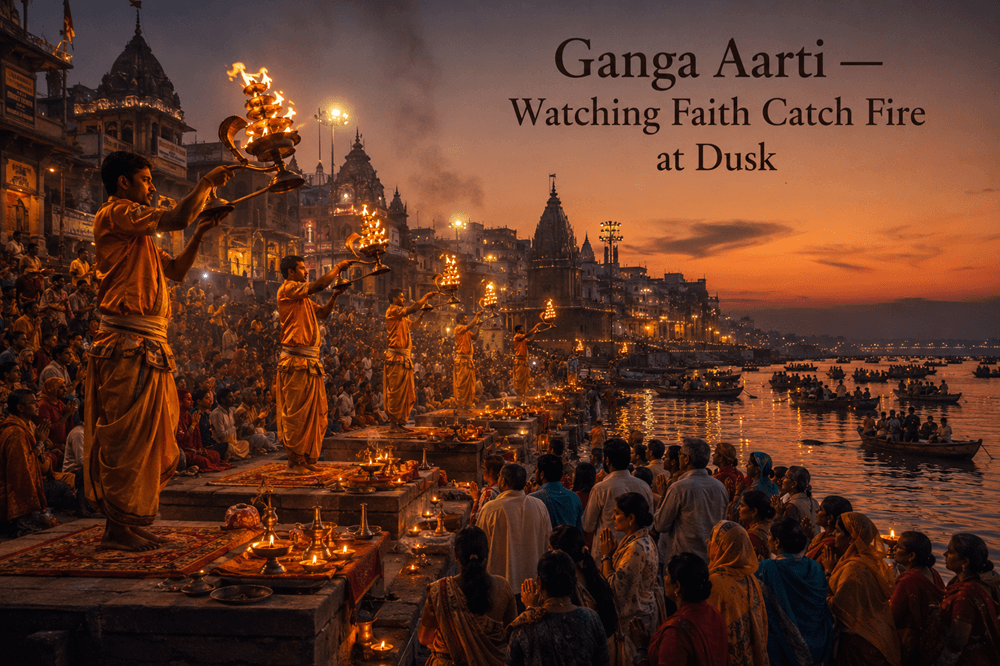
Every evening at Dashashwamedh Ghat, young priests in saffron robes perform the Ganga Aarti — raising multi-tiered brass lamps in synchronised, circular motions to the sound of bells and chanting. It's theatrical, deliberately so, but the devotion behind it is entirely sincere. Arrive early if you want a spot with a clear view; the crowd builds fast.
The Galis of Kashi
Behind the ghats, a maze of narrow lanes hides silk looms, hole-in-the-wall shrines, and eventually the Kashi Vishwanath Temple. GPS gives up pretty quickly in here, and that's more or less the point — getting mildly lost is part of how you're meant to experience it.
A Banarasi Morning
Mornings in Banaras move at their own pace. Kachori from stalls that have been in the same family for generations, lassi from shops with a local following, and paan bought almost as punctuation to a meal — none of it is rushed, and most of it is best eaten standing at the counter.
Where Life and Death Sit Side by Side
Manikarnika Ghat, where cremations happen around the clock, is one of the more confronting sights in the city — and also one of the most honest. Banaras doesn't treat death as something to sanitise or look away from; it's simply part of daily life here, which is unsettling and clarifying in roughly equal measure.
Beyond the River
Sarnath, a short drive out of the city, offers a quieter, more contemplative version of Banaras's spirituality — this is where the Buddha is believed to have given his first sermon. Banaras Hindu University's sprawling, leafy campus is worth a walk for a change of pace. And the city's own classical music tradition, the Banaras gharana, still shapes how a lot of Indian classical music is taught and performed today.
When to Go
October through March brings the most comfortable weather for walking the ghats and lanes. Three to four days is enough to get a real feel for the city without rushing it — Banaras rewards slowness more than it rewards a packed itinerary.