
12 Jyotirlingas in India: A Sacred Journey to the Abodes of Lord Shiva
By KindQuest Travel
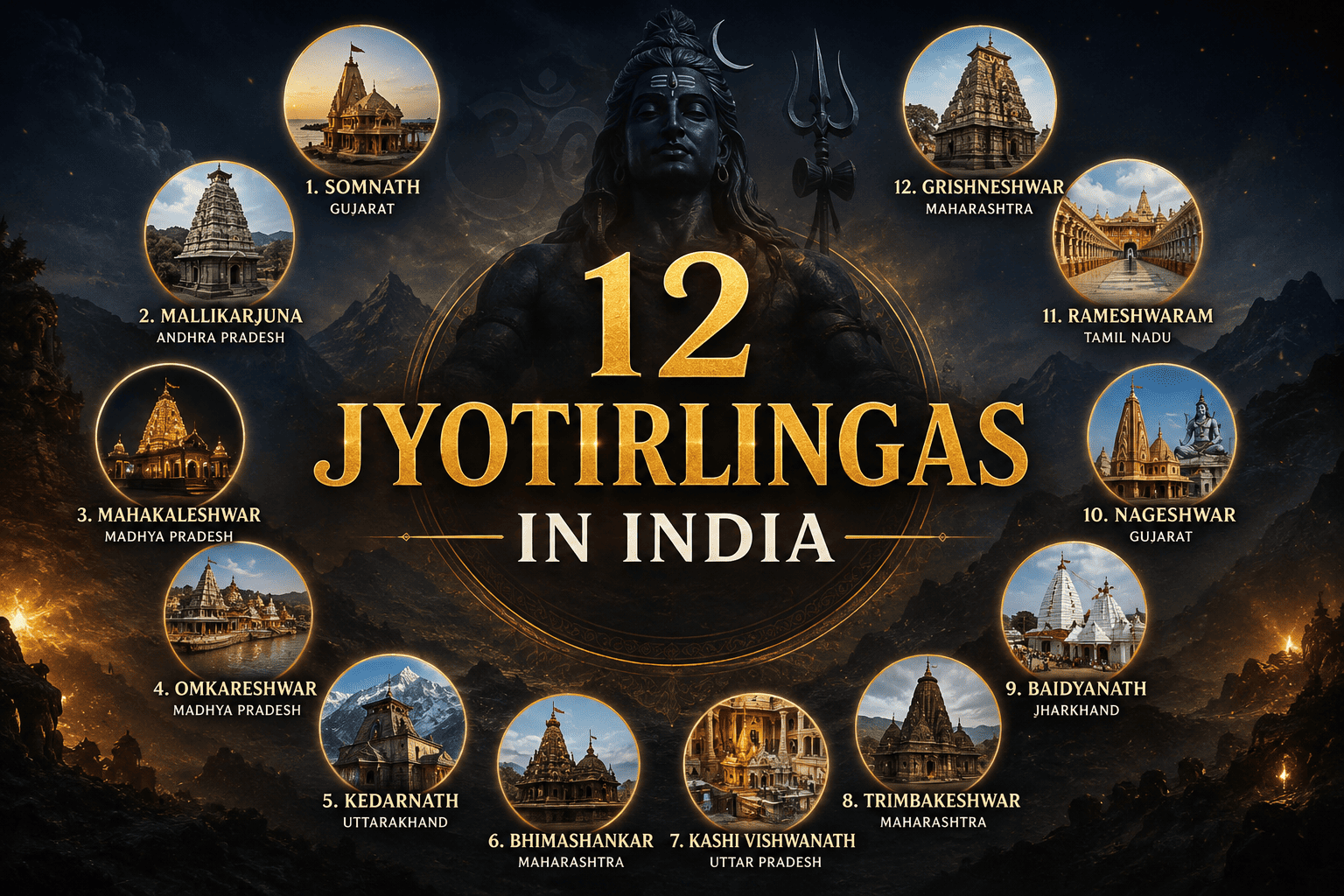
India is a land of spirituality, ancient traditions and sacred pilgrimage sites. Among the most revered are the 12 Jyotirlingas of Lord Shiva — sacred temples believed to represent the divine manifestation of Shiva as a Jyoti, or pillar of light. The word Jyotirlinga comes from the Sanskrit "Jyoti" (light) and "Linga" (representing Shiva).
1. Somnath — Gujarat
Traditionally regarded as the first of the twelve Jyotirlingas, Somnath sits on Gujarat's western coast beside the Arabian Sea. It's particularly famous for its association with Chandra, the Moon God, who is said to have worshipped Shiva here after being cursed by Daksha Prajapati. The temple's long history of reconstruction is often seen as a symbol of the resilience of Indian spiritual traditions.
2. Mallikarjuna — Srisailam, Andhra Pradesh
Traditionally counted as the second Jyotirlinga, the Mallikarjuna Swamy Temple at Srisailam is significant because the site honours both Shiva as Mallikarjuna and Goddess Parvati as Bhramaramba — a Jyotirlinga and Shakti Peetha at the same sacred site, popularly known as the "Kailash of the South."
3. Mahakaleshwar — Ujjain, Madhya Pradesh
Dedicated to Shiva as Mahakal, the lord associated with time, this temple is distinctive for its underground chamber housing a swayambhu (self-manifested) lingam, and for the Bhasma Aarti, an early-morning ritual that draws large crowds of devotees.
4. Omkareshwar — Khandwa, Madhya Pradesh
Situated on an island in the Narmada River, traditionally shaped like the sacred symbol Om, Omkareshwar's island setting makes it one of India's most distinctive Jyotirlinga destinations, with a temple complex known for traditional architecture and a large pillared prayer hall.
5. Kedarnath — Uttarakhand
Among the most dramatic Jyotirlingas in terms of setting, Kedarnath stands high in the Garhwal Himalayas at around 3,580 metres, surrounded by snow-covered peaks and the Mandakini River. It's also one of the four sites of the Chhota Char Dham circuit, traditionally associated with the Pandavas.
6. Bhimashankar — Pune district, Maharashtra
Set in the forested Sahyadri region, Bhimashankar is connected to the Bhima River and known for traditional Nagara architectural influences and intricate carvings — a temple that combines spirituality with the natural beauty of its surroundings.
7. Kashi Vishwanath — Varanasi, Uttar Pradesh
Located in one of the world's oldest continuously inhabited cities, Kashi Vishwanath is also called the Golden Temple for the gold plating on its spire and dome, standing close to the Ganga. The present form dates to the 18th century under the patronage of Ahilyabai Holkar.
8. Trimbakeshwar — Nashik, Maharashtra
Near the Brahmagiri Hills and closely associated with the origin of the Godavari River, Trimbakeshwar is distinctive for its Shiva Lingam, traditionally described as having a three-faced manifestation associated with Brahma, Vishnu and Shiva. The sacred Kushavarta Kund within the temple area is linked to the Godavari's origin.
9. Baidyanath — Deoghar, Jharkhand
Baba Baidyanath Dham is unique for being revered as both a Jyotirlinga and a Shakti Peetha, with legends involving Shiva and Ravana. During Shravan, the temple receives an especially large number of pilgrims.
10. Nageshwar — Near Dwarka, Gujarat
Associated with the ancient Darukavana legend, the deity here is regarded as a self-manifested form of Shiva, with a large statue of Lord Shiva near the temple among its most recognisable features. Nageshwar's proximity to Dwarka makes it an important stop for pilgrims visiting Gujarat's major religious sites.
11. Rameshwaram — Tamil Nadu
The Ramanathaswamy Temple is significant for its association with Lord Rama, who is said to have worshipped Shiva here before his journey to Lanka. Shiva is worshipped as Ramanathaswamy — "the Lord of Rama" — and the temple is also known for its enormous corridors and numerous sacred water tanks.
12. Grishneshwar — Verul, near the Ellora Caves, Maharashtra
The twelfth Jyotirlinga in the traditional list, Grishneshwar sits close to the Ellora Caves, making it a notable combination of spiritual and heritage tourism. The present temple is associated with the reconstruction efforts of Maharani Ahilyabai Holkar and features traditional Maratha architectural elements.
The 12 Jyotirlingas and Sawan
The month of Sawan (Shravan) holds special significance for Shiva devotees, who visit temples, perform Abhishekam and offer water, milk and Bilva leaves during this period. A pilgrimage to one or more Jyotirlingas during Sawan is considered a particularly meaningful spiritual experience.
From the coastal beauty of Somnath and the Himalayan grandeur of Kedarnath to the sacred lanes of Kashi and the historic surroundings of Grishneshwar, every Jyotirlinga offers a unique experience — together, a journey of faith, devotion and spiritual discovery across India's diverse landscapes.